Behind the Scenes: How to Record High-Converting Paid Ads Without Overthinking It
Behind the Scenes: How to Record High-Converting Paid Ads Without Overthinking It
If you want to launch a new agency, consultancy, or scale your current business into a brand new vertical, the fastest way to do it is through paid traffic. But in order to run good ads, you need great videos. The problem? Most business owners are terrified of recording ads. They think it requires a Hollywood production crew, a perfect script, and flawless delivery.
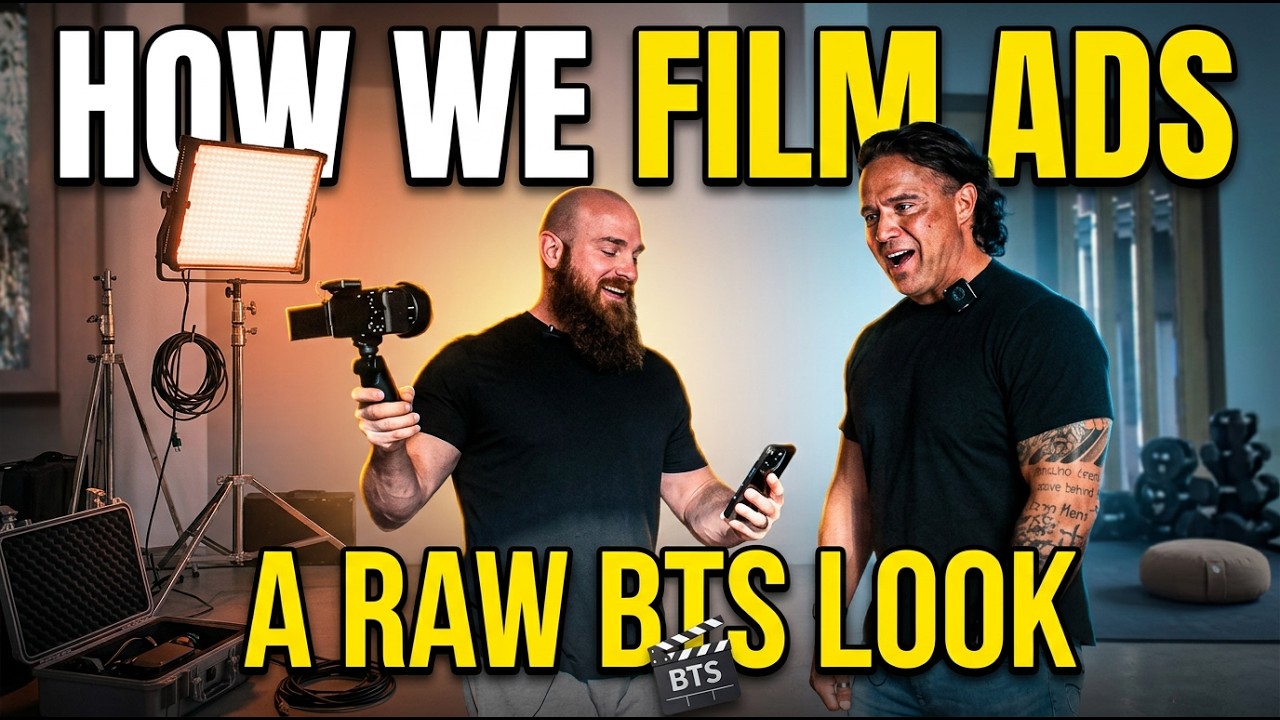
In this post, we're taking you behind the scenes of an actual ad recording session. We'll break down the psychology of marketing, the simple framework for structuring your ads, and the practical tips for recording raw footage that your editor can turn into gold. It's a hell of a lot less intimidating than you think.
The Psychology of Recording Ads
Before you hit record, you need to understand that all marketing is psychology. Whether you are speaking to gym owners or med spa owners, your personality has to shine through. Marketing is a transference of energy. You are trying to put your energy into the prospect on the other end of the screen to get them excited.
Because you aren't in the room with them, you often have to elevate your energy slightly to get your point across and capture their attention. Why should they listen to you versus someone else? It comes down to authenticity. People truly care about authenticity right now, which is why the best-performing ads are rarely overly produced. They are usually just face-to-camera, speaking directly to the ideal client about the conversations they are already having inside their own heads.
The "Tease, Please, Seize" Framework
You don't need a complex script to run a successful ad. A really simple framework, popularized by Kevin Harrington from Shark Tank, breaks every ad down into three parts: Hook, Body, and Call to Action — or Tease, Please, Seize.
1. The Hook (Tease)
The hook is your first one to three seconds. Its only job is to stop the scroll. Eyeballs have a tendency to stop on faces, so a face-to-camera shot is a great start. Your verbal hook needs to tease them in — whether it's the promise you're making, the offer you're delivering, or the problem you're solving. You want them to think, "I need to hear the rest of this."
2. The Body (Please)
Once you've hooked them, you have to fulfill the promise you just made. This is the body of the ad. You please them by delivering the value or context they stayed to hear. Good ads speak directly to the prospect's pain points and offer a new way forward. Really good ads communicate things the ideal client is thinking but not saying out loud to others.
3. The Call to Action (Seize)
Finally, you have to tell them exactly what to do next. You cannot assume the prospect knows where to click. If you want them to go to a landing page, say, "Click the link somewhere around this video, go to the next page, and enter your information." If you want them to book a call, tell them to apply and grab a demo. You are selling them on taking the next step — and that is a sale in itself.
When to Place Your Call to Action
There is no single right answer for when to drop your CTA. Some people are ready to click the moment they hear the offer. Others need to be taken through the full story first. If you are running a two-minute ad, you can have multiple calls to action — even one in the first 15 seconds. It all depends on where the viewer is in their buyer's journey and how the copy is written. The key principle is this: sell them to the next level, not the final destination.
Practical Tips for Recording Raw Footage
The biggest mistake people make when recording ads is trying to "one-shot" it. They get stressed about memorizing a 60-second script perfectly. Here is how to actually record your ads without losing your mind:
- Record in Chunks: A 60-second ad might result in a 6-minute raw file. That is completely fine. Read one to three lines of your script, look at the camera, and deliver them. Then look back at your script for the next lines.
- Pause Before and After: When you finish a sentence, wait a full second before looking away or breaking character. This makes it infinitely easier for your editor to stitch the clips together harmonically.
- Use a Teleprompter App: If you struggle to remember lines, use a teleprompter app on your phone with an auto-scroll feature. Just ensure you position it close to the camera lens so it doesn't look like you are reading.
- Don't Be Afraid to Go Off-Script: Once you know the core message, let your personality take over. Add dramatic effect, lean into the camera, and have a real conversation.
- Frame Your Shot Correctly: If you are shooting vertically, keep your head in the top third to top half of the frame. Don't put your head all the way at the top, or it will get cut off by the platform's UI elements. If shooting horizontally, keep your arm extended and give yourself head room above.
- Don't Worry About Mistakes: If you don't like a take, just pause and do it again. Your editor will pull the best version. The raw file can be 10 minutes long — nobody cares.
Keep It Simple and Start Somewhere
The best ad you can run is the one you actually record. Don't wait for perfect lighting, a perfect script, or a perfect delivery. Start with your face, your message, and your offer. With each recording session, your camera presence and confidence will improve. The framework stays the same — your execution just gets sharper over time.
Disclaimer: The strategies and frameworks discussed in this post are based on our own experiences running paid traffic campaigns. Individual results may vary depending on your market, offer, and execution.
